The Story
From paper grids to the cloud.
MusicOne’s story runs from a high-school DJ in Arkansas in 1964 to the music scheduler in the cloud it is today. Along the way the tools changed from paper to the Mac, Windows and the browser. The belief behind them didn’t.
How it started
t was the summer of 2021. Steve Warren was doing an early-morning shift in his home office when the phone rang. That call led, eventually, to MusicOne Cloud.
On the other end of the line was Trond Frost. Trond had worked in radio since 1996, building and developing stations in Norway, the UK, the Baltics, Russia and South Africa, and several of them became number one in their markets. Along the way he had worked with virtually every major music scheduler, and seen where each one fell short of how good programmers think about music. Steve Casey, MTV’s first Music Director, had told him to talk to Steve.
That conversation was different.
◂◂ Rewind to 1964
To see why, you have to start where Steve did: at a small radio station in Arkansas, in 1964.
Paid to play records, still in high school.
In July 1964, just before his junior year of high school, Steve got his first radio paycheck: part-time DJ at KOTN in Pine Bluff, Arkansas, working for owner and general manager Buddy Deane, one of the early pioneers of Top 40 radio. By January 1965 he had the evening shift, full-time.

Program director at 18, learning the craft by hand.
In January 1967 KOTN made him program director. He was 18. Over the years that followed he learned to format, rotate and control music flow from some of the best in the business. It was all done by hand: hour-grids on paper, numbers on the records, and matching numbers written into the hour-slots. When two “conflicting” songs came up by the numbers, Steve showed the air staff how to handle it.


A dozen markets, then his own consultancy.
Through the ’70s Steve worked a dozen markets as program director, operations manager, music director and DJ, with commercial and TV voice work, jingles and ad copy on the side. In 1981 he started his own consultancy for CHR, A/C and Country stations, and by the mid-’80s he was pioneering what became Hot Country: faster tempos, more current hits, and quick ratings gains for his clients. He wrote it all down: “The Programming Operations Manual”, a how-to on music radio formatting bought by some 4,000 broadcasters, and in 1991 “Repositioning Country Radio”, which more than 200 PDs and managers used as their game plan.

The first music scheduler for the Mac.
Steve bought a Macintosh for his consulting business and started imagining how it could do his hand formatting and rotation, with precise control over song spins and category rotation patterns. An application developer turned his instructions into code, and in October 1987 MdB debuted: the first (and only) music scheduler for the Mac, with graphical format clocks, interactive scheduling and click-and-drag editing. It drew much acclaim but few users: radio ran on PC-DOS, and the price of a Mac kept MdB out of most stations.

Music 1, the first music scheduler for Windows.
In 1992 Steve brought in another software engineer to rebuild it for Windows, and in the fall of 1994 Music 1 shipped: the first Windows-native music scheduling software, designed by a radio programmer rather than a committee. It went on to stations worldwide, later with a Special Edition for internet radio, and stations have scheduled with it for more than thirty years. All through the ’90s Steve kept working in radio too: consultant to top-rated Country stations, frequent contributor to trade publications, and panel member at broadcast conventions.
Music 1 for Windows today →
▸▸ Back to 2021
Why it clicked.
Music 1 was the first scheduler Trond had found that scheduled the way he believed radio should be programmed. Behind it was everything Steve had learned since KOTN.
An idea: rebuild it for the cloud.
Towards the end of 2024 the idea came up to rebuild Music 1’s way of scheduling for the browser, so music directors are no longer tied to one computer at the station. Trond brought in two engineers to build it: Robbert Scholten and Edi Duluman.
MusicOne Cloud.
Steve, Trond, Robbert and Edi released MusicOne Cloud: the third generation of the scheduler Steve first designed on a Mac in 1987. The same way of scheduling, now in your browser and on your phone.
How MusicOne schedules →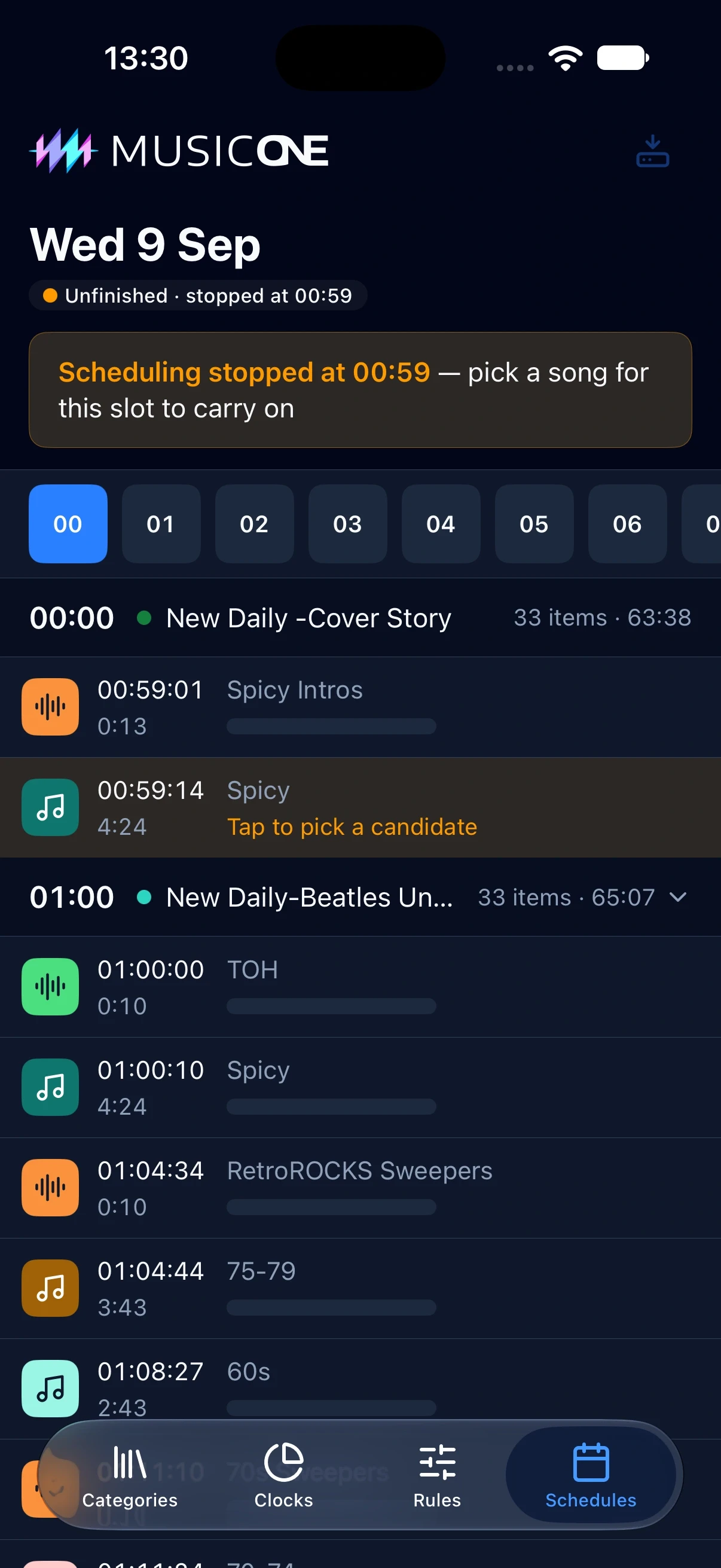
Good radio still comes down to rotation.
Great radio has never been about playing the newest songs the loudest. It’s about rotation, flow and consistency: a station that sounds hand-picked every hour of every day. Steve scheduled that way on paper hour-grids in 1967. MusicOne Cloud is built on the same belief today.
Free for 30 days. No credit card, nothing to cancel.